
Living Museum of Learning
Her Finger Touched the Venn Diagram
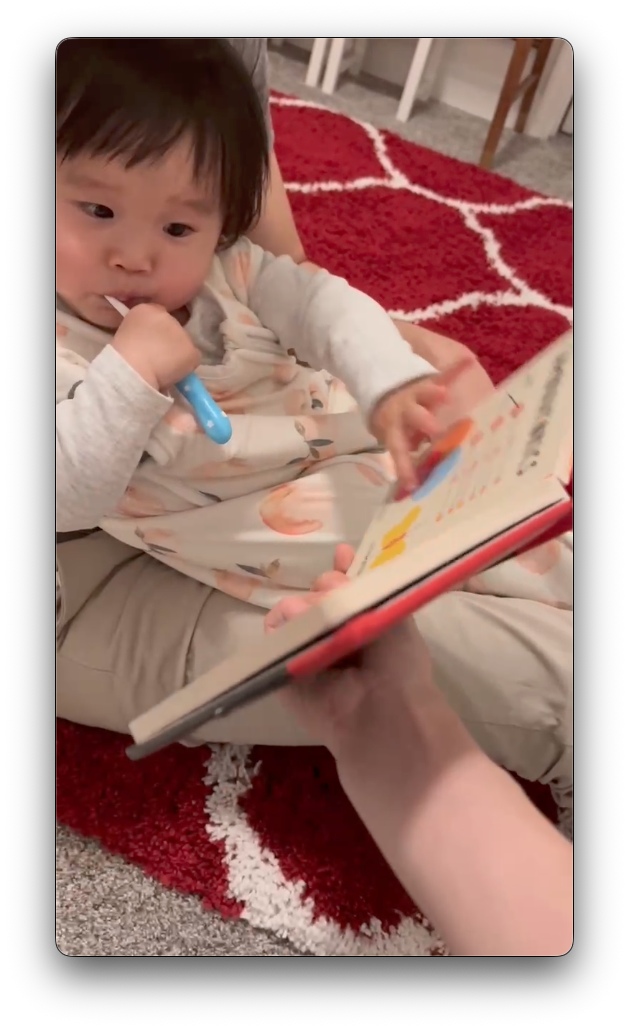
Rhea, about 18 months old, sits wrapped in a sleeping bag, resting on her father’s lap after brushing her teeth. The atmosphere is calm and intimate.
Her mother opens a book titled Combinatorics for Babies. On the page is a colorful Venn diagram.
There is no expectation that she will understand it. Only shared presence.
As the mother softly reads “combinatorics,” Rhea leans forward.
She holds a toothbrush in her mouth and slowly extends her small hand toward the overlapping region of the Venn diagram.
She touches it.
The mother responds gently: “Yeah~ That’s Venn diagram.”
A brief acknowledgment. A shared moment of attention.
Nothing dramatic happens externally.
But something subtle forms: alignment between perception, language, and curiosity.
The child does not “learn” set theory.
She experiences intersection as something visible, touchable, and socially mirrored.
Meaning begins not as explanation, but as recognition.
Early exposure is not about comprehension—it is about familiarity.
Mathematical ideas such as sets, overlap, and structure can enter a child’s world as visual and emotional impressions long before symbolic understanding.
Repeated gently over time, these impressions accumulate into intuitive comfort with abstraction.
Language, imagery, and touch become three parallel channels of cognition.
Even before language or formal reasoning, children can form intuitive familiarity with mathematical structures through visual and tactile experience.
Through repeated, low-pressure exposure where adults name patterns in the child’s environment without demanding understanding—only attention.
Early cognitive development is not built from instruction alone, but from accumulated moments of shared attention that later become the foundation for abstract thinking.
Intelligence is not taught in a moment—it is tuned over time.